Some people spend their entire lives fighting “darkness” without realizing they may actually be fighting disconnection.
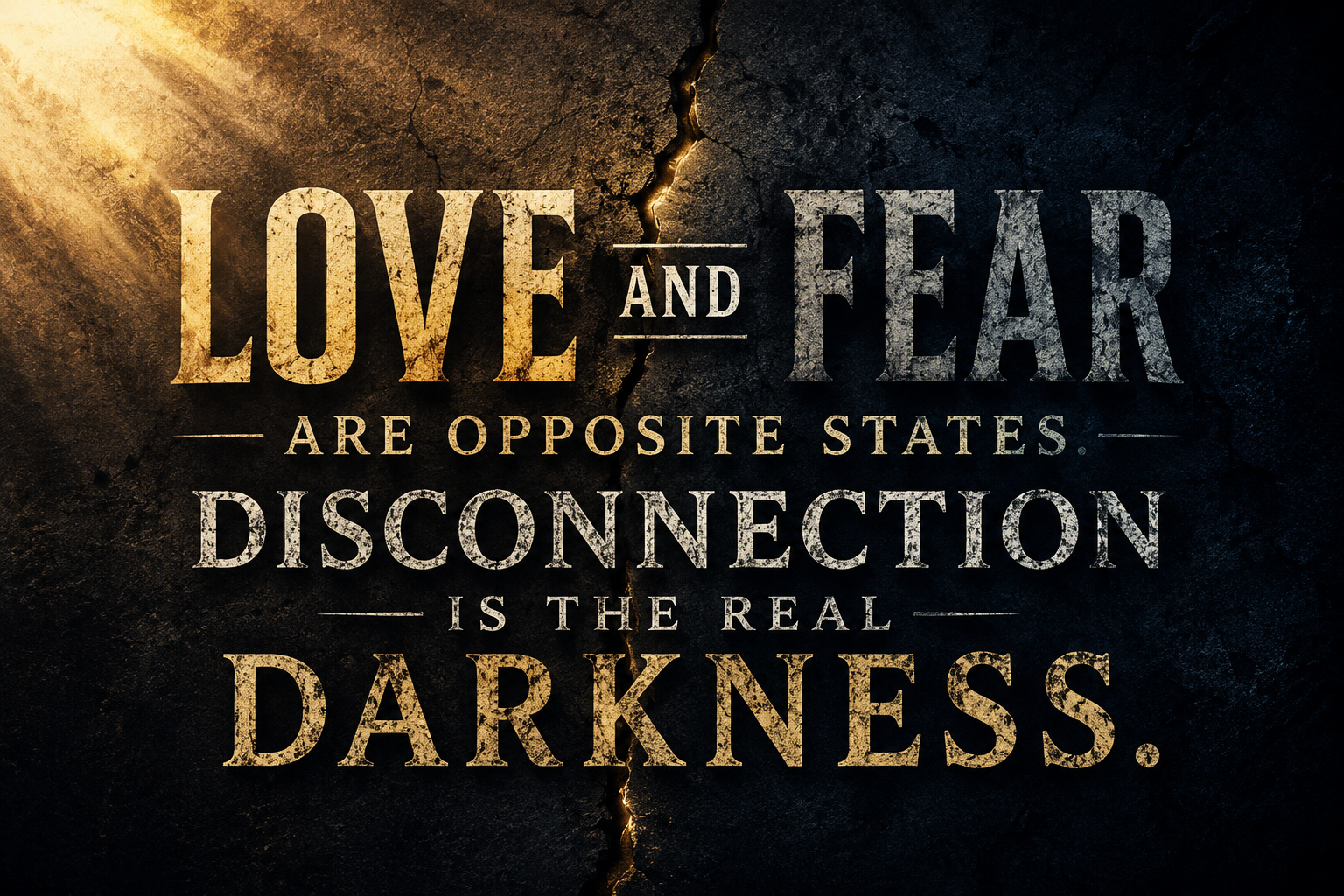
What if fear is not the opposite force of love, but the psychological condition that appears when love stops being experienced?
That possibility changes the conversation completely.
Love and fear behave like opposite internal states. When people feel connected to something deeper than themselves, certain qualities tend to emerge naturally:
- trust
- compassion
- courage
- generosity
- clarity
Those patterns usually grow out of connection.
But when people feel internally cut off, isolated, threatened, or fractured, another pattern often appears:
- fear
- control
- hostility
- suspicion
- isolation
That condition can feel like separation from the deeper source that keeps human life grounded and ordered.
In that framework, some thinkers interpret “Satan” less as a literal monster and more as a symbol of adversarial consciousness itself.
Historically, the Hebrew term śāṭān carried meanings like adversary, accuser, or opposer. The idea fits surprisingly well with the mental state produced by division, blame, fear, and hostility.
So the symbolic structure looks something like this:
- Love represents alignment, connection, and participation in a deeper order.
- Fear represents the experience of separation and fragmentation.
- “Satan” represents the adversarial mindset that grows out of that separation.
The comparison is similar to darkness and light.
Darkness is not a substance by itself. It is what remains when light is absent.
In the same way, some thinkers argue fear is not necessarily a “thing” on its own. It is what the mind begins producing when connection, meaning, compassion, and truth start disappearing from experience.
And that may explain why fear-driven states often begin fading when people reconnect with humility, honesty, compassion, and genuine human connection.
Not because the darkness was violently destroyed.
Because the light came back on.