If Nehemiah 1–12 is about rebuilding the wall, Nehemiah 13 is about discovering that rebuilding the wall did not automatically rebuild the people.
In the Westminster Leningrad Codex, the chapter opens with the public reading of the Torah. The people realize they have drifted from the standards they had previously agreed to follow. Almost immediately, Nehemiah finds multiple failures inside the system.
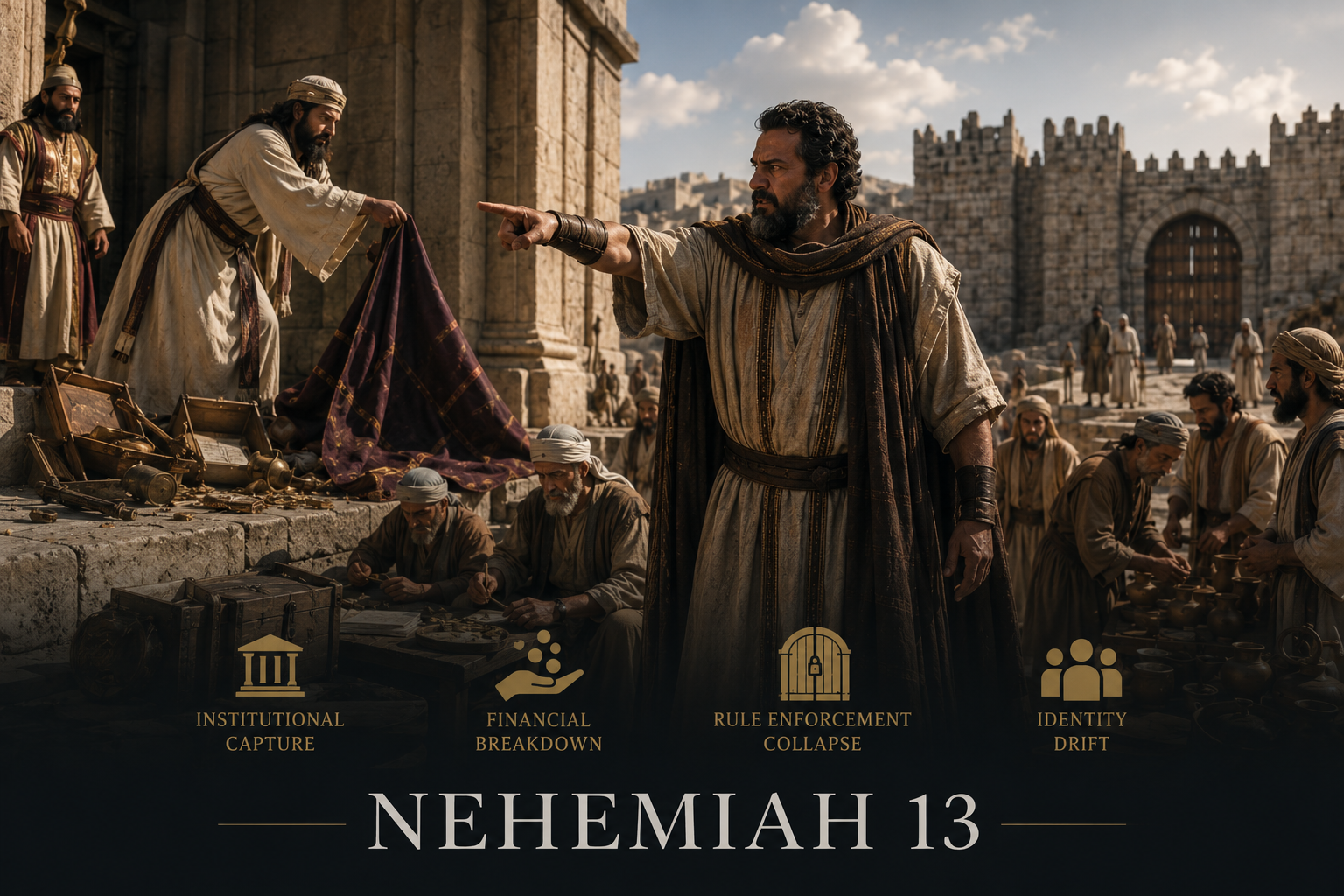
The chapter unfolds in four major problems:
1. Institutional Capture
A priest named Eliashib gives temple space to Tobiah, a political opponent of Jerusalem’s restoration effort. Nehemiah returns, sees what happened, and literally throws Tobiah’s belongings out of the temple chambers.
From a systems perspective:
The institution still existed.
The building still stood.
The leadership titles remained.
But someone with conflicting interests had quietly moved into the center of the institution.
The problem wasn’t the wall.
The problem was governance.
2. Financial Breakdown
Nehemiah discovers that the Levites have abandoned their duties because they are no longer being supported. The people stopped bringing the required contributions, so workers left to support themselves. Nehemiah restores the storehouses and financial system.
The pattern is familiar:
Organizations often fail long before they collapse visibly.
Support systems weaken.
People stop contributing.
Workers disengage.
The mission suffers.
3. Rule Enforcement Collapse
Nehemiah finds merchants conducting business on the Sabbath.
His response is direct.
He orders the city gates shut before the Sabbath begins and warns traders lingering outside the walls that he will act against them if they continue.
The larger issue is not commerce.
The issue is whether agreed standards still mean anything.
Every society eventually faces the same question:
Are rules merely words, or are they actually enforced?
4. Identity Drift
Nehemiah also confronts marriages that he believes are causing the next generation to lose its connection to the community’s language and traditions. The text notes that some children could no longer speak the language of Judah.
In the ancient context, language was not merely communication.
Language carried law, memory, culture, and identity.
Nehemiah sees a community slowly forgetting who it is.
The Bigger Pattern:
What makes Nehemiah 13 fascinating is that the crisis arrives after the victory.
The wall is finished.
The dedication ceremony already happened.
The celebration is over.
Yet the system immediately begins drifting.
History repeatedly shows the same thing:
Building something is difficult.
Maintaining it is harder.
Whether it is a nation, business, church, family, or institution, success often creates the conditions for complacency. People assume the problem is solved because the visible project is complete.
Nehemiah’s final message is almost uncomfortable:
A restored system still requires constant maintenance.
Walls do not preserve a community.
People do.
Source: Westminster Leningrad Codex, Nehemiah 13.