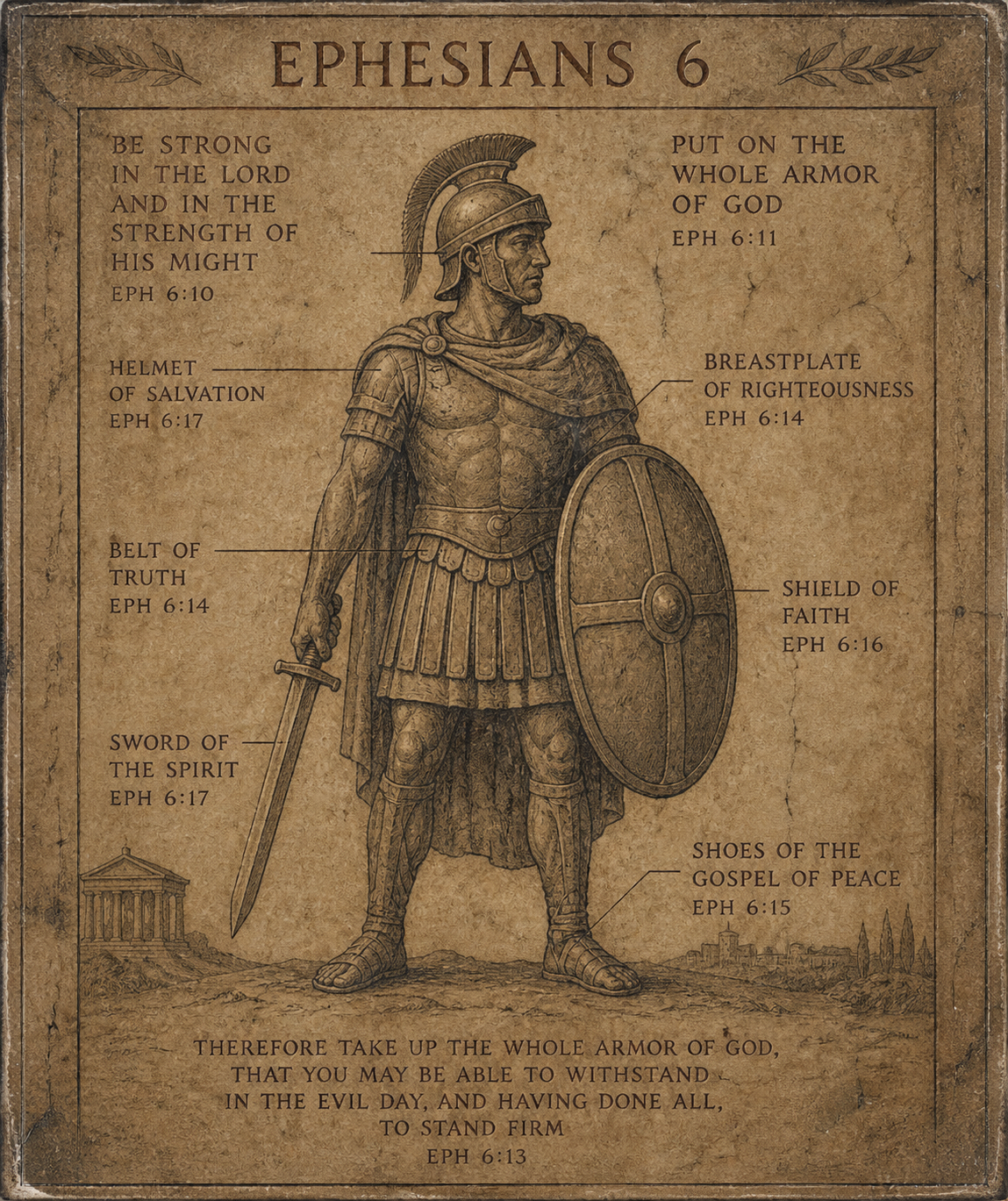
Ephesians 6 presents a structured view of how individuals are meant to function within layered systems such as family, work, and internal discipline. The Greek text emphasizes that this is not about abstract belief, but about lived alignment expressed through behavior and intention.
The chapter begins with guidance for children and parents. The Greek verb hypakouō (ὑπακούω) conveys the idea of “listening under,” which implies responsive attention rather than blind obedience. It reflects a posture of trust, learning, and alignment. At the same time, fathers are cautioned not to provoke their children to anger, using the term parorgizō (παροργίζω), which highlights the risk of misusing authority in ways that generate resentment. Instead, children are to be raised through paideia (παιδεία), meaning disciplined formation, and nouthesia (νουθεσία), meaning corrective instruction. Together, these terms describe a process of intentional development rather than control. Authority, in this framework, is designed to build maturity, not to impose domination.
The text then shifts to relationships defined by work and power. Here, the Greek language emphasizes internal motivation rather than external structure. The phrase met’ eunoias (μετ’ εὐνοίας), meaning “with goodwill,” indicates that actions should be carried out with sincerity of intent. Similarly, hōs tō Kyriō (ὡς τῷ Κυρίῳ), “as to the Lord,” establishes an internal standard that transcends human oversight. Those in positions of authority are held to the same standard, as the text explicitly states there is no prosōpolēmpsia (προσωπολημψία), or partiality. Status does not alter accountability. This creates a system in which both leadership and service are governed by the same ethical framework.
A transition occurs in verse 10, where the focus turns to the source of strength. The verb endynamousthe (ἐνδυναμοῦσθε) is passive, meaning “be strengthened,” which indicates that strength is not self-generated but received. This is reinforced by the phrase en Kyriō (ἐν Κυρίῳ), “in the Lord,” pointing to connection as the source of empowerment. Strength, in this context, is not defined by force or effort alone, but by alignment with a greater source.
The well-known imagery of the “armor” is then introduced. The Greek verb endyō (ἐνδύω), “to put on,” suggests adopting or embodying specific internal qualities. Each element represents a distinct component of stability and coherence. Alētheia (ἀλήθεια), or truth, refers to what is real and unconcealed. Dikaiosynē (δικαιοσύνη), or righteousness, describes alignment with what is just and properly ordered. Euangelion (εὐαγγέλιον), the “good news,” functions as a stabilizing message that prepares and grounds action. Pistis (πίστις), often translated as faith, conveys trust, reliability, and relational confidence. Sōtēria (σωτηρία), or salvation, denotes preservation and wholeness. Finally, rhēma (ῥῆμα), the spoken word, refers to a precise and timely expression. Together, these elements form a cohesive internal framework rather than a set of external defenses.
The nature of conflict is clarified in verse 12. The text states that the struggle is not against “flesh and blood,” using the phrase ouk estin hē palē pros haima kai sarka (οὐκ ἔστιν ἡ πάλη πρὸς αἷμα καὶ σάρκα). The term palē (πάλη) refers to close, personal struggle, emphasizing that while conflict may feel interpersonal, its true source lies elsewhere. The opposing forces are described with terms such as archai (ἀρχαί), exousiai (ἐξουσίαι), and kosmokratores (κοσμοκράτορες), which denote ruling powers, authorities, and system-level forces. These terms point to underlying structures that shape behavior and outcomes beyond what is immediately visible.
The chapter concludes with an emphasis on sustained awareness through prayer. The terms proseuchē (προσευχή) and deēsis (δέησις) refer to prayer and specific petition, while en panti kairō (ἐν παντὶ καιρῷ) underscores the need for consistency “at all times.” The participle agrypnountes (ἀγρυπνοῦντες), meaning “remaining alert,” highlights attentiveness rather than ritual. The focus is on maintaining continuous alignment and awareness, ensuring that one does not drift out of position.
In summary, Ephesians 6 outlines a coherent framework for operating within complex systems without being controlled by them. It redefines authority as responsibility, work as an expression of internal alignment, strength as derived from connection, and conflict as rooted in deeper structural forces rather than surface-level interactions. The “armor” functions as an internal architecture of stability, enabling individuals to remain grounded and effective regardless of external conditions.