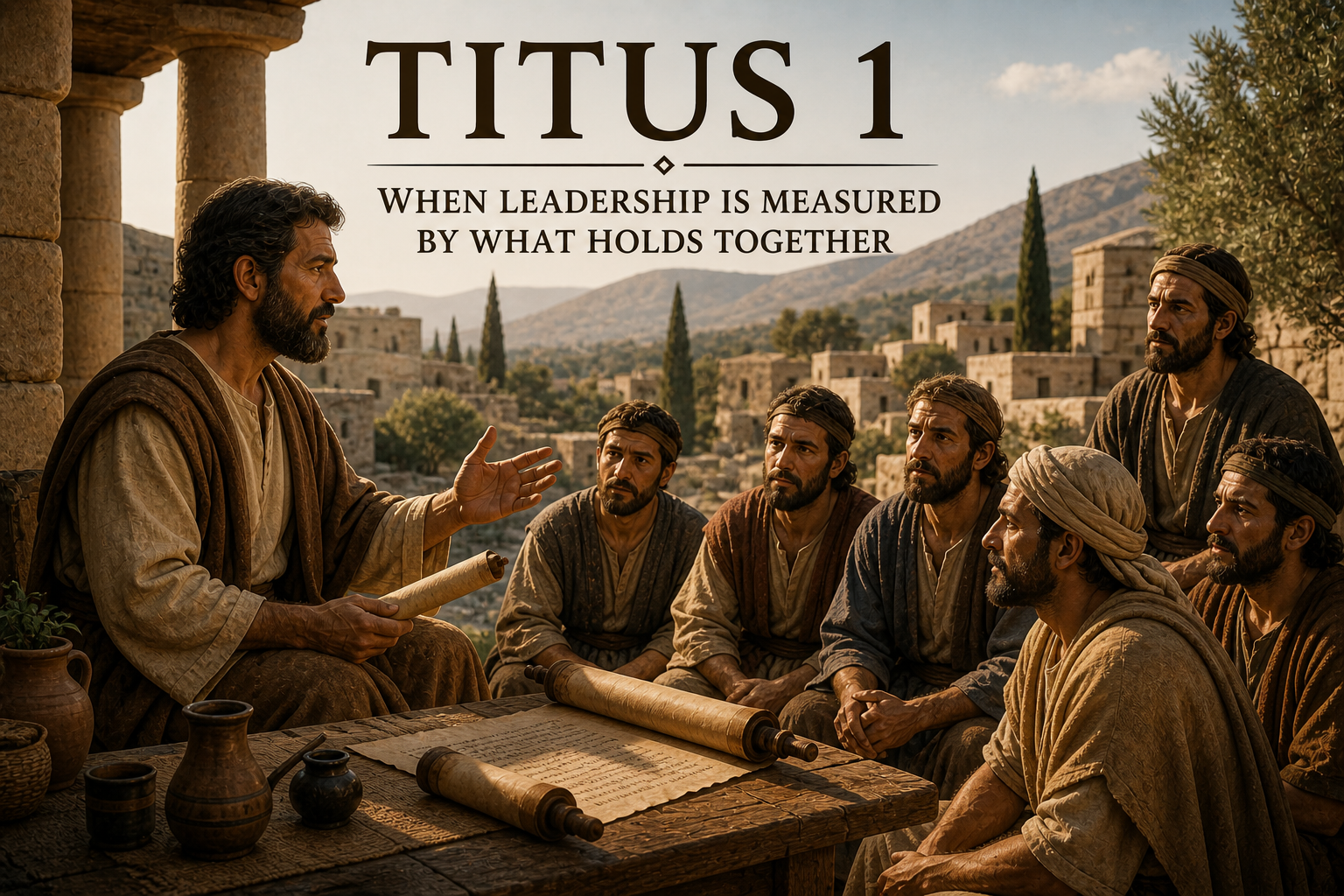
Titus 1 begins by establishing purpose and responsibility. Paul presents his role as one centered on strengthening trust and deepening understanding. The goal is not abstract knowledge, but a clear grasp of truth that shapes how people actually live. What is understood is meant to show up in behavior.
Titus is then given a specific task: to bring order to what is unfinished. This includes appointing leaders who are defined by consistent character, not just position. The standard is straightforward. A leader should be stable, reliable, and not open to serious accusations. The focus is on integrity across everyday life, including how a person manages their household, their self-control, and their overall conduct.
The qualities listed point to balance and discipline. A leader should be steady, fair, and consistent in both judgment and behavior. At the same time, certain traits are clearly ruled out. Arrogance, impulsive anger, and self-serving behavior undermine trust and create instability. The distinction is practical: some traits build clarity, while others create confusion.
A central requirement is holding firmly to a trustworthy message. This allows a leader to both encourage others and correct what is off course. The role involves active responsibility, not passive oversight. It requires the ability to maintain clarity and address problems when they arise.
Paul then identifies a pressing issue. Some individuals resist structure and promote empty or misleading ideas. Their influence is not harmless. It disrupts others and creates instability, even within households. The concern is not just that they are wrong, but that their impact spreads.
The response is direct. Their influence needs to be stopped so it does not continue to cause damage. The focus is on protecting the integrity of the group. Paul also notes that these behaviors are often driven by personal gain, which further explains their persistence.
He supports this by pointing out a broader cultural pattern of inconsistency and lack of discipline. The intent is not to generalize unfairly, but to explain why firm correction is necessary. The goal is to restore clarity so that people develop a sound and steady understanding.
The chapter closes with a contrast in perception. Those who are clear-minded tend to see things as they are. Those who are internally compromised struggle to interpret things accurately. The issue goes beyond behavior and affects how reality itself is understood.
The final point is direct. It is possible to claim alignment while living in contradiction to it. In the end, actions reveal what is real. Words alone are not enough.
At its core, Titus 1 is about establishing reliable leadership and protecting clarity within a group. It connects belief, behavior, and responsibility into a single standard: what is true must be reflected in how a person actually lives.