Leviticus opens with a problem most people spend their lives trying to avoid:
What happens when humanity can no longer casually approach the source of life?
That is the tension underneath every sacrifice, every ritual, and every drop of blood in Leviticus 1.
The Westminster Leningrad Codex begins with God calling to Moses from the Tent of Meeting. That detail matters because Exodus ended with the divine presence filling the tabernacle so intensely that even Moses could not enter freely. Leviticus begins where direct access became complicated.
The first major word introduced is qorbān (קָרְבָּן), usually translated “offering” or “sacrifice.” But the Hebrew root q-r-b means “to draw near.”
That changes the entire frame.
The system is not primarily about destruction.
It is about the approach.
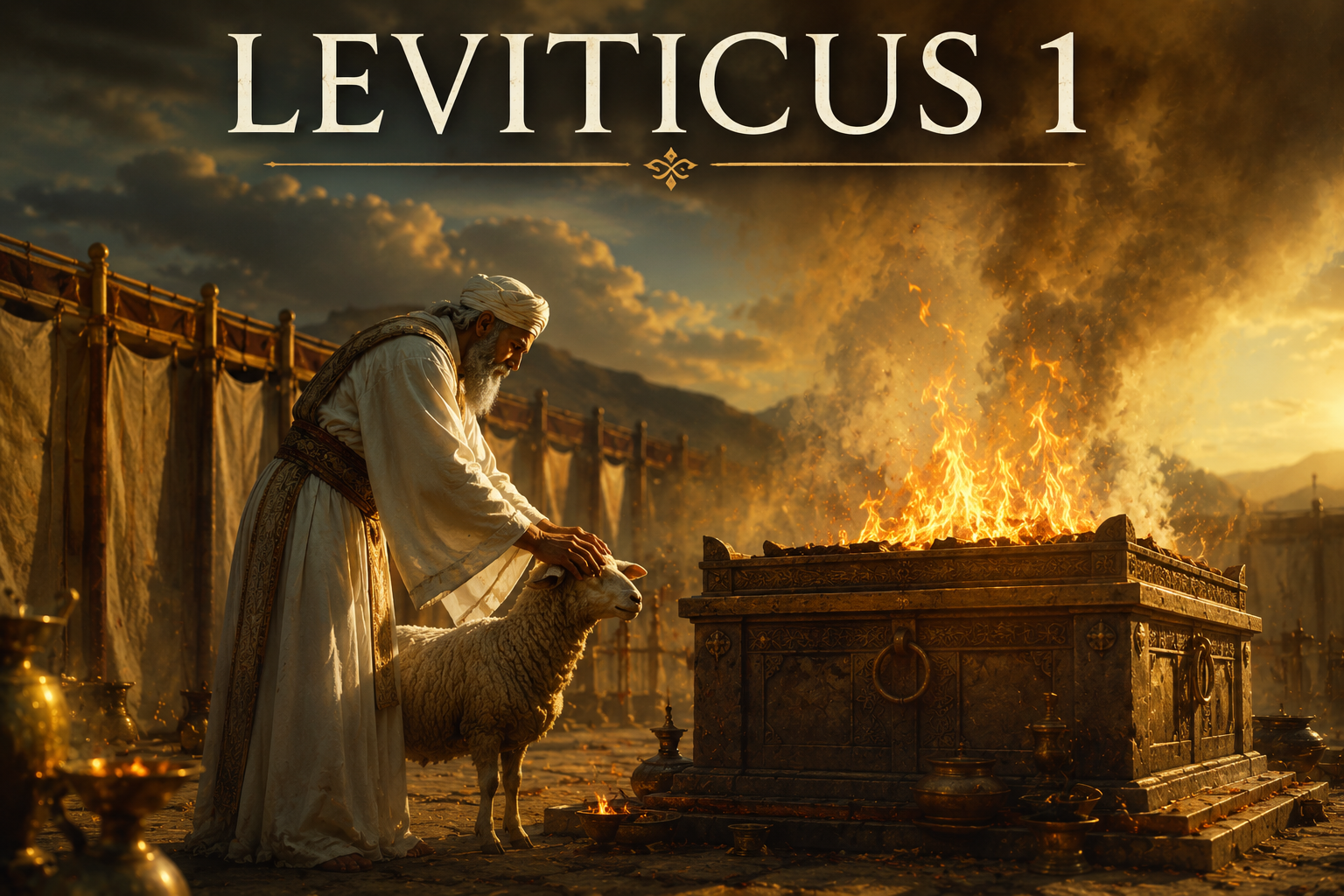
Leviticus 1 focuses on the ʿōlāh (עֹלָה), the burnt offering. The Hebrew word comes from a root meaning “to ascend.” The offering rises upward completely in smoke. Nothing is held back. Nothing remains partially surrendered.
The worshiper brings an animal “without blemish” (tāmîm, תָּמִים). The Hebrew idea is not cosmetic perfection. It points to wholeness, integrity, completeness. What approaches the sacred cannot be casually selected or internally fractured.
Then the ritual becomes intensely physical.
The worshiper places a hand on the animal.
The animal is killed.
Blood is handled openly.
The body is divided.
The pieces are arranged carefully.
Everything is consumed by fire.
Leviticus refuses abstraction. The text slows the process down so the weight of it cannot be ignored. Nearness to holiness is treated as costly, serious, and dangerous.
One of the central lines appears in verse 4:
“It shall be accepted for him to make atonement.”
The Hebrew word kippēr (כִּפֵּר) carries the idea of covering, purging, or restoring a broken relationship. The ritual is functioning as a repair. Something disordered is being addressed, so the approach becomes possible again.
Modern readers often struggle with the blood imagery, but within Leviticus, blood represents life itself. The rituals communicate that human corruption is not theoretical. It affects the structure of the relationship between humanity and the divine order.
And Leviticus does something important here that often gets overlooked.
The offerings scale according to economic ability.
A wealthy person may bring a bull.
Others may bring sheep or goats.
The poor may bring birds.
The cost changes.
Access does not.
The system makes room for everyone to approach, not just the powerful.
Repeated throughout the chapter is the phrase:
“A pleasing aroma to YHWH.”
The Hebrew expression does not mean God literally enjoys the smell of burning flesh. It communicates acceptance. Restored alignment. Obstruction removed.
Leviticus 1 operates from the assumption that fractured humans cannot drift casually into sacred space unchanged. The approach requires recognition, surrender, and restoration.
That is why the chapter feels heavy.
It is supposed to.
Genesis showed humanity losing direct access to the source. Leviticus begins building the system for how nearness might be possible again without everything collapsing under the weight of the fracture.