The first murder in the Bible happens before cities fully rise.
That matters.
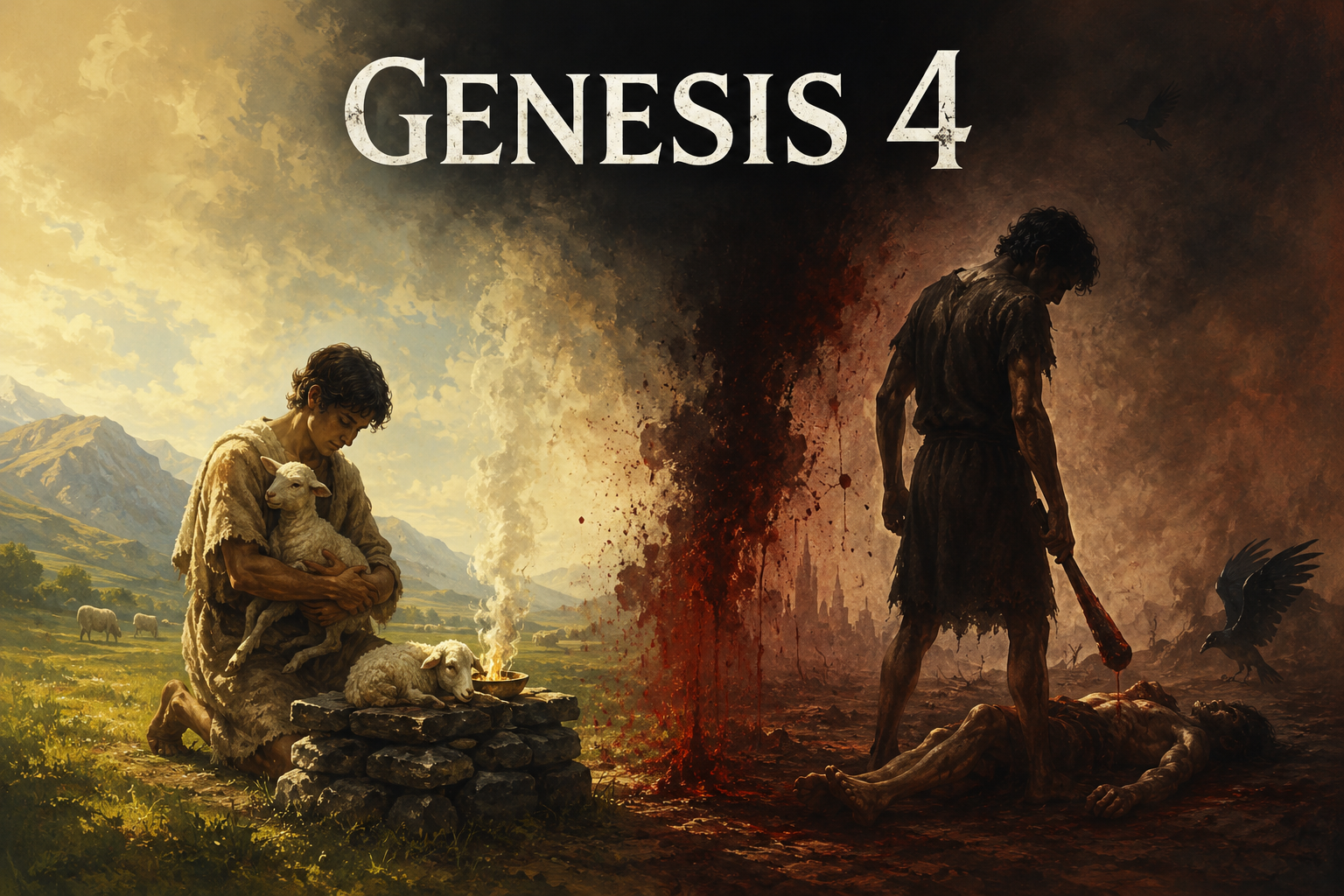
Genesis 4 is not just the story of Cain and Abel. It is the story of what happens after the fracture in Eden begins spreading through human relationships, culture, and eventually civilization itself.
The Westminster Leningrad Codex opens the chapter with two brothers moving in different directions from the start. Cain’s name (Qayin, קַיִן) is tied to the Hebrew root meaning “to acquire” or “to possess.” Abel’s name, Hevel (הֶבֶל), means vapor, breath, something temporary. One sounds established. The other sounds fragile.
Cain works the ground.
Abel tends flocks.
Both bring offerings.
But the text quietly gives more attention to Abel’s. Cain brings produce from the soil. Abel brings the firstborn and the fat portions from his flock. The narrative emphasizes intentionality without fully explaining why one offering is accepted and the other is not.
That silence is important.
The real focus is not the sacrifice.
It is Cain’s response.
The Hebrew says his face “fell.” Anger moves inward before violence moves outward. Then comes one of the sharpest warnings in Genesis:
“Sin is crouching at the door.”
The Hebrew word rōvēts (רֹבֵץ) describes a predator lying in wait. Sin is not presented as ignorance or accident. It is something active, patient, and ready to consume.
“Its desire is for you, but you must rule over it.”
The conflict is now internal. Genesis 3 showed temptation entering humanity. Genesis 4 shows humanity beginning to lose control of itself.
Then the narrative becomes brutally direct.
Cain speaks to Abel.
They go into the field.
Cain rises against him.
Cain kills him.
No dramatic buildup.
No emotional monologue.
The Hebrew moves quickly because violence often does too.
Then comes the question:
“Where is Abel your brother?”
It mirrors the earlier question in Eden:
“Where are you?”
The progression matters. Separation from the source now becomes separation from each other.
Cain answers with deflection:
“Am I my brother’s keeper?”
The Hebrew word shōmēr (שֹׁמֵר) means guardian or protector. Cain rejects responsibility for another human life entirely. The fracture has evolved into moral detachment.
Then the ground itself becomes part of the judgment.
Abel’s blood “cries out” from the earth. The soil Cain once cultivated now resists him. He becomes restless, unstable, wandering. The disorder inside him begins reshaping the world around him.
But Genesis 4 does something unexpected.
Cain is judged, yet protected.
A mark is placed on him so vengeance does not immediately spiral into endless retaliation. Even in judgment, restraint still exists.
Humanity, however, keeps escalating.
The second half of the chapter shows rapid cultural development:
- cities are built
- livestock systems expand
- music develops
- metalworking emerges
Civilization advances.
But character does not advance with it.
That becomes clear through Lamech. Unlike Cain, who feared consequences, Lamech boasts about violence publicly. He speaks about killing a man over an injury and escalates revenge beyond Cain entirely.
Violence is no longer regretted.
It is celebrated.
That is the real warning of Genesis 4. Human progress and human maturity are not the same thing. Technology can evolve while morality collapses. Systems can expand while the human condition deteriorates underneath them.
The chapter ends with the birth of Seth and a quiet shift in direction:
“At that time, people began to call on the name of YHWH.”
After the violence, the wandering, and the escalation, humanity still reaches outward for connection to the source it keeps separating from.