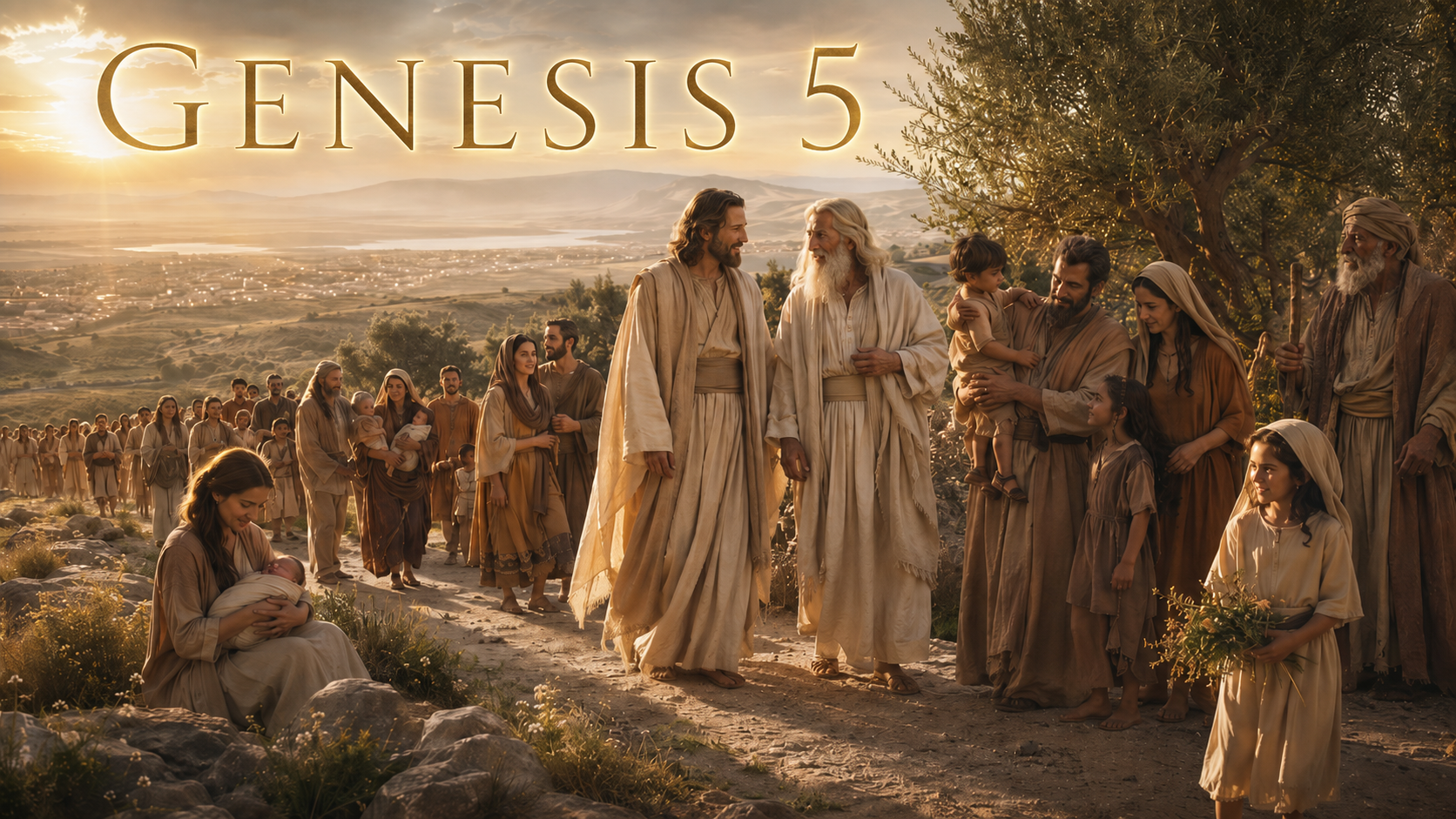
Genesis 5 is a long record of people being born, living, having children, and dying.
At first, it can feel like a list of names and numbers. But beneath the surface, it is showing something simple and profound:
Life on earth is temporary.
Each person arrives, lives for a time, affects others, passes something forward, and eventually leaves.
The repeated phrase “and he died” is not there to erase human worth. It is there to remind us that no one possesses this life permanently.
We are passing through.
The question is not only how long we live.
The deeper question is what state we choose to live in while we are here.
Human Worth Comes Before Achievement
Genesis 5 begins by repeating that humanity was made in the likeness of God.
That comes before the record of accomplishments, failures, years lived, children born, or religious behavior.
Human worth is given first.
It is not earned by living long enough, understanding enough, behaving perfectly, or becoming spiritually impressive.
The text does not say humanity became valuable through knowledge or obedience.
It says humanity was made with value from the beginning.
That means dignity is not a reward.
Love is not a prize for the most religious person.
Mercy is not only for those who have studied enough.
People may forget who they are. They may act from fear, pride, anger, or confusion. But their need for correction does not mean they have no worth.
Books, Scripture, prayer, and wise teachers can help people remember. They can act as lamps and mirrors. But they do not create human value.
They help uncover what fear and woundedness have hidden.
You are already loved.
You do not need to earn your worth.
And because you are loved, you can keep learning how to love others better.
Adam Passes More Than a Family Name
The chapter says that Adam had a son in his own likeness and image.
This means each generation receives more than physical life.
Children receive ways of thinking, emotional patterns, fears, habits, and beliefs about themselves and others.
They may inherit love.
They may also inherit shame, control, judgment, resentment, or self-condemnation.
The next generation often receives patterns it did not choose.
But receiving a pattern is not the same as being permanently defined by it.
Each person still has the freedom to decide what they will practice.
They can continue harshness.
They can continue fear.
They can continue judgment.
Or they can begin practicing mercy, kindness, forgiveness, and love.
Free will is not only choosing between isolated actions.
It is choosing what kind of inner state to walk in.
“And He Died”
The repeated words “and he died” create the rhythm of the chapter.
No matter how many years someone lives, the same ending comes.
This reminds us that the Earth is not something we can permanently possess.
We may build homes, create systems, collect wealth, gain influence, and form identities around what we own.
But eventually, we release all of it.
The temporary cannot become permanent simply because we cling to it.
Genesis 5 quietly removes the illusion of control.
No one remains here forever.
No one fully owns the earth.
No one can keep a body, title, possession, or position permanently.
We are guests moving through an experience.
That does not make life meaningless.
It makes the way we treat one another more important.
If our time is temporary, then domination is empty.
Judging others becomes a poor use of the little time we have.
Control becomes exhausting.
Love becomes the most meaningful thing we can practice and pass forward.
The Earth Is Not a Trophy
Genesis 5 does not describe humanity conquering the earth.
It describes humanity moving across it through generations.
One person enters.
Another person leaves.
The line continues.
This suggests that the Earth is not our final home or permanent possession.
It is a place where we experience, choose, learn, help, and eventually move on.
To say the Earth is temporary does not mean we should neglect it.
We can feed people.
We can heal wounds.
We can protect nature.
We can repair harm.
We can forgive.
We can create beauty.
The difference is motive.
Love helps without needing to dominate.
Control tries to force the temporary world to satisfy its fear.
Love honors the gift while it is here.
Control clings because it is afraid of loss.
Genesis 5 shows that loss cannot be completely prevented.
So the healthier path is not possession.
It is presence.
Length of Life Is Not the Same as Depth of Life
The people in Genesis 5 are described as living extraordinarily long lives.
But the text does not say the longest life was automatically the most loving, wise, or spiritually clear.
Length is not the same as depth.
A person can live many years while practicing resentment.
Another person can live fewer years while bringing mercy and peace into every room they enter.
The value of life is not measured only by duration.
It is also reflected in the state in which we live.
Did we become harder or softer?
Did we increase fear or reduce it?
Did people feel smaller around us or more seen?
Did we help others remember their dignity?
Did we treat them as we would want to be treated?
The genealogy records years, but the soul of a life cannot be reduced to a number.
Enoch Walked With God
Enoch is the one person who breaks the repeated pattern.
The chapter says Enoch “walked with God.”
This is not mainly about religious performance.
It describes a way of being.
Walking happens step by step.
It is not one perfect decision.
It is a state chosen repeatedly.
Enoch’s life can be understood as moment-by-moment alignment with love, truth, mercy, and presence.
He still lived in the same temporary world.
He still belonged to the same human family.
But he did not allow the fear and heaviness of mortality to become the condition of his inner life.
He walked differently.
This is what free will looks like at its deepest level.
It is not merely choosing what to do.
It is choosing what spirit to act from.
Will I respond from fear or love?
Will I condemn or show mercy?
Will I hold resentment or release it?
Will I attack myself, or will I remember that I also deserve compassion?
What we repeatedly choose becomes the state we carry.
We Become What We Practice
Genesis 5 shows repetition across generations.
Repetition forms patterns.
This is also true within a single person.
What we practice grows stronger.
If we practice judgment, we become more judgmental.
If we rehearse resentment, we become heavier.
If we constantly condemn ourselves, self-condemnation begins to feel like truth.
But it is still a practiced state.
It is not our deepest identity.
Love can also be practiced.
Mercy can become natural through repetition.
Kindness can become the first response instead of the last.
Forgiveness can loosen what resentment has tightened.
Helping others can also heal the helper because it moves the person out of isolation and back into connection.
“You are love” does not mean every action is loving.
It means love is not foreign to you.
You do not have to manufacture it from nothing.
You are being called to remember it and act from it.
Noah and the Hope for Relief
When Noah is born, his father hopes he will bring comfort from the pain and labor of life.
This is a deeply human hope.
People often look for someone outside themselves to remove the weight they feel.
They may expect a child, partner, teacher, religious leader, or spiritual system to save them from their inner burden.
Others can help.
They can offer guidance, comfort, and truth.
But no person can permanently make another person choose love.
No one else can completely remove the state we continue practicing within ourselves.
Noah may bring relief in the story, but he cannot make the whole human family inwardly whole.
Real transformation still involves choice.
A person must choose whether to keep walking in fear or begin walking in love.
The Spiritual Question Beneath the Genealogy
Genesis 5 records how many years each person lived.
But the deeper spiritual question is not:
How long did they live?
It is:
How did they live while they were here?
Were they present?
Did they love?
Did they show mercy?
Did they reduce suffering?
Did they treat others as they wished to be treated?
Did they learn to forgive themselves and others?
Did they mistake the temporary for the eternal?
Did they spend their lives trying to possess what could never be kept?
These questions turn the genealogy into a mirror.
The chapter is not only about ancient people.
It asks us to examine the state we are walking in now.
How Much Self-Love Do You Have Today?
This is one of the most important questions we can bring to Genesis 5.
Not because life should revolve around the self.
But because people who deeply hate themselves often spread that pain outward.
Self-condemnation can become judgment.
Shame can become control.
Fear can become cruelty.
A lack of inner mercy can make it difficult to offer mercy to anyone else.
Love creates the safety in which honest change becomes possible.
How This Pattern Appears Today
Self-love does not mean pride or believing we are better than others.
It means accepting the dignity already given.
It means refusing to treat ourselves in ways we would recognize as cruel if done to another person.
It means remembering:
I am still worthy of mercy while I am learning.
I am still worthy of love while I am healing.
I do not have to punish myself into becoming good.
People still try to earn what was already given.
They study to prove they are worthy.
They become religious to escape shame.
They perform goodness in order to feel lovable.
They judge others to avoid facing their own pain.
They try to control people, systems, and outcomes because they are afraid of how temporary everything is.
Genesis 5 exposes the futility of that pattern.
Everything temporary eventually passes.
But the love we practice changes the quality of the life we are living now.
A person may not be able to control the whole world.
They can still feed someone.
They can listen.
They can forgive.
They can protect what is vulnerable.
They can stop repeating inherited cruelty.
They can choose not to condemn themselves today.
These may seem like small actions, but they change the state in which a person lives.
And that state influences everyone they touch.
The Central Pattern
Genesis 5 presents two ways of moving through temporary life.
One way is unconscious repetition.
We inherit fear, practice judgment, cling to the temporary, pass the same heaviness forward, and die without ever examining the state we lived in.
The other way is represented by Enoch.
Walk consciously.
Walk with love.
Walk with mercy.
Remember your worth.
Help others remember theirs.
Care for the earth without trying to possess it.
Allow life to be a gift rather than a territory to conquer.
The point is not to become “religious enough.”
The point is to become more awake to the love already calling from within.
Genesis 5