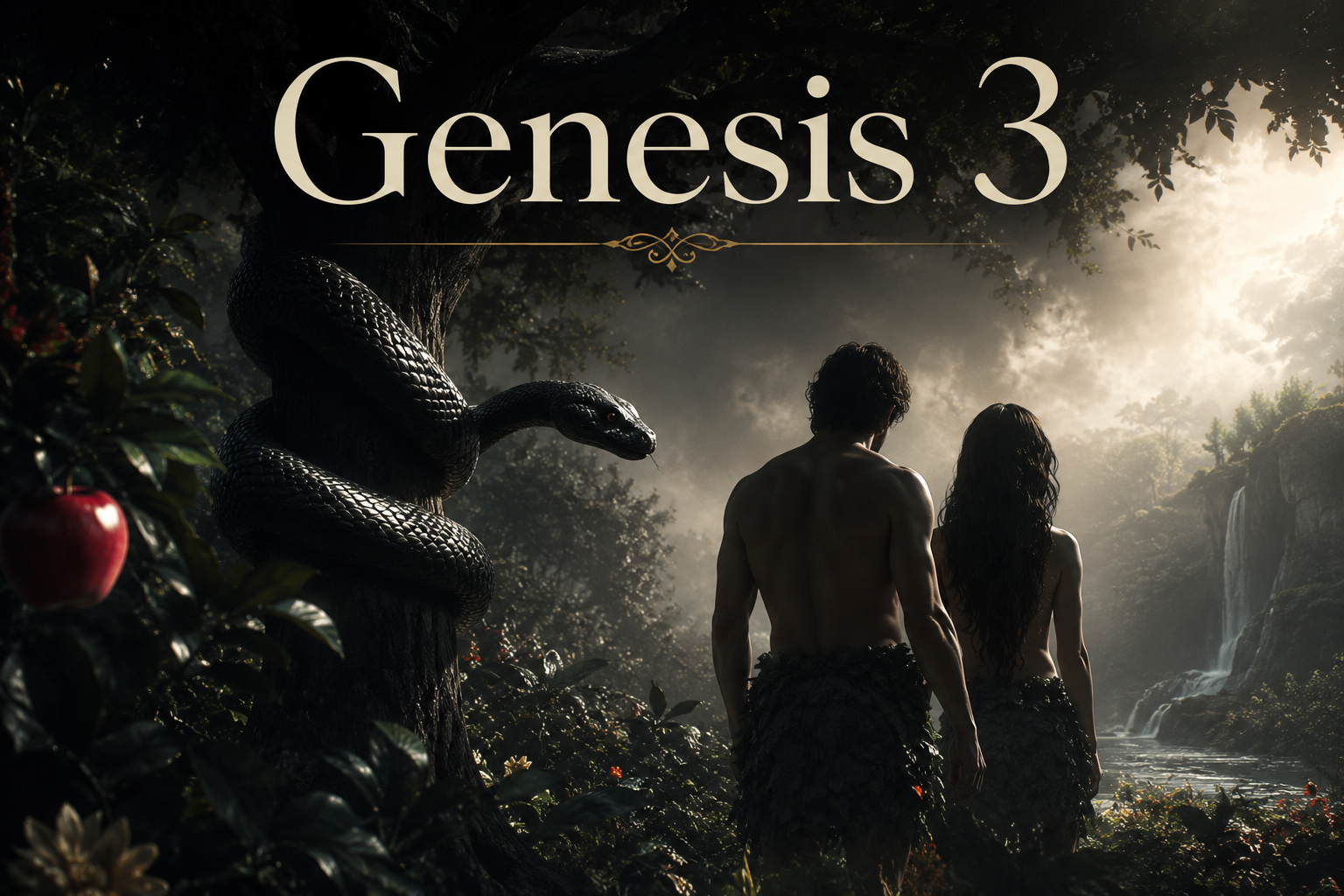
The collapse of humanity in Genesis 3 does not begin with eating fruit.
It begins with a conversation.
The Westminster Leningrad Codex presents the serpent as ʿārûm (עָרוּם), “crafty” or “shrewd.” The Hebrew intentionally echoes the previous chapter, where the humans were described as ʿărummîm (עֲרוּמִּים), “naked.” One word points to an exposed vulnerability. The other points to manipulative cleverness. The connection is deliberate.
The serpent never starts with direct rebellion. It starts with distortion.
“Did God really say…?”
That question changes everything. The command is reframed before it is denied. Confusion enters first. Separation comes later.
The woman responds, but the wording has already shifted slightly from the original instruction in Genesis 2. The boundary becomes less clear. Then the serpent attacks the consequence directly:
“You will not surely die.”
The Hebrew phrase môt tamût (מוֹת תָּמוּת) means “dying you shall die.” It communicates certainty. The serpent’s strategy is not simply a contradiction. It is the destabilization of trust itself.
Then Genesis describes the tree through three escalating layers:
- Good for food
- desirable to the eyes
- able to make one wise
The Hebrew word le-haskîl (לְהַשְׂכִּיל) refers to gaining insight or understanding. The issue is not intelligence. The issue is humanity reaching for the authority to define good and evil independently from the source that established reality.
The moment they eat, their eyes are opened.
But what enters the story is not enlightenment.
It is a shame.
For the first time, the humans hide. They sew coverings together because the fracture has become internal. Fear appears immediately after. When God asks, “Where are you?” the question is not about physical location. It exposes relational distance.
Then the blame begins.
Adam blames the woman.
The woman blames the serpent.
Nobody takes ownership of the rupture.
Genesis 3 presents human nature with uncomfortable accuracy. Once trust collapses, responsibility usually scatters outward.
The consequences that follow are larger than punishment. They describe disorder spreading through the entire human experience:
- relationships fracture
- Labor becomes exhausting
- The ground resists cultivation
- pain increases
- mortality becomes unavoidable
The disturbance moves outward from the human heart into the structure of life itself.
One of the most important lines appears in Genesis 3:15. The text describes ongoing hostility between the serpent and the woman’s “seed” (zeraʿ, זֶרַע). In the immediate Hebrew context, this establishes an enduring conflict between deception and humanity. Later traditions build further meaning onto the passage, but the core idea is already present here: the fracture will continue through history.
Then, unexpectedly, the chapter slows down.
God makes garments for them.
Before exile comes covering.
Even after rebellion, the humans are not abandoned or exposed in their shame.
The chapter ends with humanity driven east of Eden, separated from the tree of life. Access to sustaining life is no longer direct. The world outside the garden becomes a place of labor, mortality, conflict, and distance.
Genesis 3 is ultimately about humanity attempting to seize moral autonomy apart from the source that gave life meaning in the first place.
The result is not freedom.
It is alienation.